
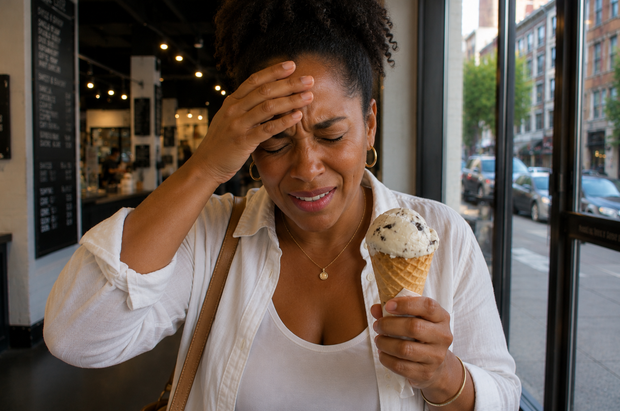
Can Brain Freeze Be Stopped?Yes, you can stop brain freeze once it starts, and most of the fixes work by warming the roof of your mouth fast. Press your tongue or thumb against your palate, sip something warm, or breathe through cupped hands. Brain freeze happens when a cold food or drink cools the blood vessels at the roof of your mouth too quickly, and your body responds by flooding the area with warm blood. That rush of blood against sensitive nerves is what actually causes the pain. |
We’ve all been there. One triumphant, oversized bite of ice cream, and two seconds later you’re frozen mid-chew with your eyes squeezed shut and your hand pressed to your forehead as if your head was about to explode. That’s brain freeze. It has nothing to do with your brain actually freezing, and everything to do with a nerve reflex that reacts a little too dramatically to a change in temperature.
This particular topic has a strange claim to fame in my practice. Years ago, an ad agency in Amsterdam went looking for an article about brain freeze, found this post, and decided it was perfect for a commercial. For six months, my advice on stopping brain freeze ran on television screens across the United Kingdom. I still don’t entirely know what to make of that, other than to say if brain freeze can make it onto British TV, it’s probably good advice.
So let’s get into what’s actually happening when it hits, and the seven things you can do about it before your next scoop.
What Actually Causes Brain Freeze?
The Science Behind the Sting

The medical term is sphenopalatine ganglioneuralgia, which is a lot of syllables for something that only lasts a few seconds. Here’s the short version: the roof of your mouth is richly supplied with blood vessels and nerve endings connected to the trigeminal nerve, the same nerve responsible for most of the sensation in your face. When something very cold touches that area quickly, your body reads it as a threat to your brain’s temperature and reacts by rapidly dilating those blood vessels to rush in warm blood. That sudden surge is what triggers the sharp, stabbing pain you feel, usually right in the middle of your forehead, even though the cold never touched your forehead at all.
Note: Your palate is basically a smoke detector that only knows one volume setting. A little cold, a lot of cold, doesn’t matter. It goes off exactly the same way, every time.
Why It Hits Some People Harder Than Others
Not everyone gets brain freeze, and researchers still don’t fully understand why. A recent review of the clinical research found that cold-stimulus headache is more common in children and adolescents than in adults, and that people who already get migraines seem to experience it more frequently and more intensely. If you’ve ever watched a kid absolutely wreck themselves on a slushie while the adults at the table sip theirs without incident, this is likely why. Their nervous systems just haven’t learned to pace the assault yet.
Note: I have seen adults devour an ice cream cone in mere seconds. Kids, on the other hand, are forced to negotiate with a cone that melts faster than they can eat it.
When Cold Discomfort Might Mean Something Else
Brain freeze is fast, forehead-centered, and gone within a minute or two. If instead you feel a lingering ache in your teeth every time you have something cold, that’s a different issue entirely, and it’s worth paying attention to. That’s usually dentinal hypersensitivity, not brain freeze, and it tends to stick around well after the cold is gone. I go into what causes that and how to manage it in Why Do You Have Sensitive Teeth?, which is worth a look if the pain in your mouth outlasts the pain in your head.
7 Ways to Stop Brain Freeze in Its Tracks

The moment it hits, your goal is simple: warm up the roof of your mouth as fast as possible. Here’s what actually works.
- Press your tongue to the roof of your mouth. Push firmly against your palate for a few seconds. This is the fastest fix I know, and it works because you’re directly warming the exact spot that triggered the reflex.
- Tilt your head back. This encourages warmer blood flow toward your head and can shorten the episode.
- Drink something warmer than what caused it. A few sips of room-temperature or warm water resets the temperature shock faster than waiting it out.
- Slow down. Give cold food a moment to warm slightly in your mouth before it reaches your palate. This is the single easiest way to avoid brain freeze altogether.
- Cup your hands over your mouth and nose. Breathing warm air quickly into your cupped hands and inhaling it through your mouth can ease the reflex.
- Press your thumb against the roof of your mouth. If your tongue can’t reach comfortably, your thumb works just as well.
- Hold the cold substance against your palate before swallowing. Since the headache actually starts after you swallow, holding the cold substance against your palate a bit longer before swallowing can prevent it from starting at all. It sounds backward, which is probably why almost nobody does it.
Note: There is an eighth option: giving up frozen treats entirely, which, from my point of view, is totally unacceptable. If brain freeze is always a problem for you but you still want to enjoy ice cream, try combining it with something hot such as putting hot fudge or a dollop on a slice of hot apple pie. A few extra calories sure, but it will mitigate the onslaught of brain freeze.
Final Thoughts
Brain freeze is uncomfortable, occasionally dramatic, and almost always harmless. It’s your body being a little overprotective of your brain, which, all things considered, is not the worst instinct to have. The tricks above will get you through it in under a minute, every time.
If the discomfort you’re feeling lives in your teeth rather than your forehead, or lingers longer than 20 to 30 seconds, that’s a conversation worth having with your dentist rather than the ice cream man.
For New Yorkers Looking for a Dentist They Can Trust
If you are in New York City and looking for a dentist who will give you straight answers without a lecture, my team and I would be glad to meet you.
Visit us at our Midtown Manhattan dental office for an experience built on clarity, warmth, and genuine care. Whether you have questions about brain freeze, sensitive teeth, or anything else on your mind, you will leave with real information and a plan.
You may have just found your new dental home.
Call us today to book your appointment, we look forward to meeting you!

Frequently Asked Questions: How to Stop Brain Freeze
1. Is brain freeze actually dangerous?
No, brain freeze on its own isn’t dangerous. It’s an uncomfortable but harmless reflex that resolves on its own within a couple of minutes, without any lasting effect on your brain or your teeth.
2. Why does brain freeze feel like it’s in my forehead if the cold hit the roof of my mouth?
This is called referred pain. The nerve that senses the cold at your palate shares a pathway with nerves that serve your forehead, so your brain misreads the signal’s location. The sensation is real, it’s just coming from a different address than it feels like.
3. Does brain freeze only happen with ice cream?
No, anything cold enough eaten or drunk quickly enough can trigger it, including iced coffee, cold water, popsicles, and frozen drinks. Ice cream is just the easiest thing to eat too fast.
4. Are kids more likely to get brain freeze than adults?
Yes, research suggests cold-stimulus headaches are more common in children and adolescents than in adults, and it tends to affect people with a history of migraines more intensely. Most people find they grow somewhat more tolerant with age, or simply learn to slow down.
5. Should I tell my dentist about frequent brain freeze?
Yes, especially if what you’re describing sounds more like tooth pain than a forehead headache. Occasional brain freeze from a fast milkshake is nothing to flag, but recurring cold sensitivity in your teeth is worth mentioning at your next visit.
While You're Here...
About Dr. Sinkin
Dr. Michael Sinkin is a general and implant dentist in Midtown Manhattan with over 40 years in practice and a Surgical Director at NYU College of Dentistry’s Continuing Education Implant Program. He has built his practice around one idea: exceptional dental care with a heart.

11 Responses
Number 8 is impossible
In lieu of #8, you can smother your frozen treat of choice with hot fudge or nuke it in the microwave. Dr. S.
Thins technique actually worked
There is only One method I use when stopping Brain Freeze. I Cough. Instantly, the brain freeze Goes Away. Every time I have brain freeze, I place my hand into a fist in front of my mouth and cough. Works Every Single Time.
Thanks for your contribution!
i had brain freeze and i tilted my head back for 10 seconds and it worked WOW! WOW!
Wish I knew that when I was a kid saved me a lot of pain
It is good to know WOW ! #777
I normally shake my head for about 4-5 sec and it normally goes
Just read all of the recent posted blogs. Really enjoyed them and learned a lot. I’ll try to remember and keep up! And yes, the piece about your surgery & infection was quite well written. We do learn by being in different circumstances!