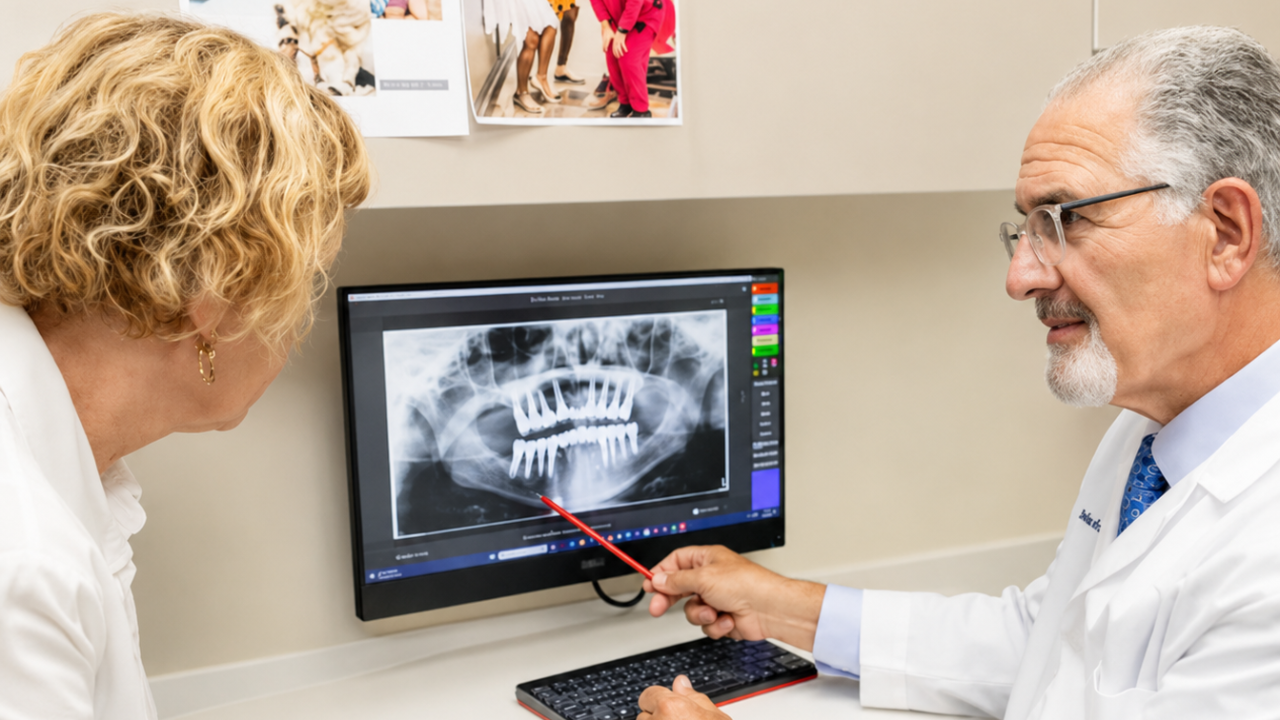
Quick Answer
Maybe. And that word matters more than you might think. A recommendation for dentures reflects what one dentist can offer, not necessarily what is possible everywhere. Many patients have real alternatives: dental implants, implant-supported restorations, or full mouth reconstruction. Whether you are being told full dentures or partial dentures also changes the conversation entirely. A second opinion is the right place to start.
I know the look.
I walk into an exam room in my office here in Midtown Manhattan to see a patient. Sometimes it’s someone who has been my patient for years, sometimes it’s someone brand new sent by a friend. They have a very particular forlorn expression, a sad resignation, that gives me a hint that they are going to start with something like: “I was told that I am losing all of my teeth and need dentures.”
It’s like the feeling of being handed a verdict in a language you don’t quite speak yet, and not knowing if you’re allowed to appeal. Most of the time, the second thing out of their mouth is something like: “Is it really that bad?” Or: “I’m only [fill in age].” Or, my personal favorite: “I just wanted a cleaning and now I’m told that I’m going to have to put my teeth in a glass of water every night!”
My response: slow down. Not because the other dentist is necessarily wrong. But because this warrants an in-depth conversation, not an off-the-cuff proclamation followed by a pass-off to the front desk to make the next appointment.
“You Need Dentures” Is a Conclusion. But You Need to Hear Why.
Most definitely there are situations where dentures are the right answer. I’ll get to those shortly. But here’s something I’ve learned over four decades of practice: a recommendation for dentures is sometimes the right call, but it can sometimes reflect a particular dentist’s bias based on the depth, or lack thereof, of their training and knowledge base. Those are not the same thing.
Full mouth reconstruction, implant surgery, and multi-stage treatment require specific training and a certain kind of practice. Not every dentist focuses on that work. So sometimes when they look at a severely compromised mouth, dentures may genuinely be the most complete solution they can offer. The most complete solution available in one office is not necessarily the most complete solution available anywhere. Before you make a permanent decision, you deserve to know if there is more on the table. Losing one’s teeth is a big deal, not only in terms of aesthetics and function, but also one’s self-esteem.
If you are in New York City, you have access to some of the most experienced implant and reconstruction dentists in the country. There is no good reason not to use that.
Note: A second opinion in dentistry is not an insult to your dentist. It is a completely reasonable thing to do before any significant, irreversible procedure. If a dentist discourages you from seeking one, that’s worth noting.
Before We Go Any Further: What Kind of Dentures Are We Actually Talking About?
This is the part that almost never gets explained in that first appointment. The word “dentures” is doing a lot of heavy lifting without much help. According to the American Dental Association, dentures can be complete (replacing all teeth in an arch) or partial (replacing some teeth while working with the ones that remain). Those are two very different situations.
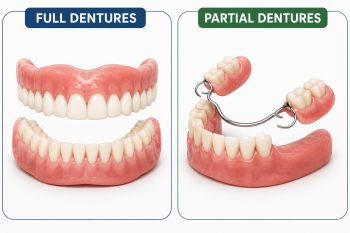
Full Dentures
A full (complete) denture replaces all the teeth in the upper or lower jaw, or both. Here is the part that causes the most panic, and I’m going to say it plainly: full dentures require the extraction of any remaining natural teeth in that arch. The denture sits on bare gum, so anything left has to come out first.
This is exactly why a second opinion matters so much, especially when full dentures are the recommendation. Extraction is permanent. Exploring your options is not.
Note: The phrase “you need dentures” usually fails to include: what type of denture, which teeth are actually at issue, what alternatives can be considered, and whether any of those teeth could be saved. Four questions. One appointment. Frequently these questions are not raised, let alone answered.
Partial Dentures
A partial denture is a very different situation. It replaces some missing teeth while your remaining healthy teeth stay exactly where they are. Those healthy teeth are what the partial clips onto for support. No extraction of sound teeth is required. If you have been told you need dentures and the recommendation is actually for a partial, your existing teeth are not going anywhere.
Note: I have had patients come in genuinely believing every tooth in their head was about to be pulled. Sometimes the dentist said “partial dentures.” The patient heard “dentures” and filled in the rest themselves. This is understandable. The word is often associated with a decline in status, health, and self-esteem.
In forty-plus years of practice, I have never once had a patient tell me their dream was to get dentures. The look on their face when I tell them there may be another path forward is genuinely one of the better parts of my job. Here is what may actually be possible.
What Are the Actual Alternatives to Dentures?
Dental Implants
A dental implant is a titanium post placed into the jawbone that acts as an artificial tooth root. A crown attaches on top. The result looks, feels, and functions essentially like a natural tooth. And implants do something conventional dentures cannot: implants preserve the jawbone. When a tooth is lost, the bone beneath it begins to shrink. Your jaw is extremely practical about this. If nothing is using the bone, the bone starts to go.
Note: Your jawbone is not sentimental. It is not keeping bone around on the off chance you might want it later. Implants give the bone a reason to stay. Conventional dentures, resting on the gum surface, do not.
Implant-Supported Bridges and Dentures
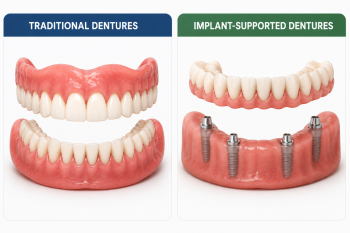
For patients missing several teeth or an entire arch, implant-supported bridges and implant-supported dentures are worth understanding. These restorations are anchored directly to implants in the jawbone. They are stable, they do not shift, and they function in a way that is fundamentally different from a conventional removable denture. The implants do the work. The restoration stays in place.
Full Mouth Reconstruction
This is the option most often left off the table. And it is the one I want to give real space to.
Full mouth reconstruction is a comprehensive, multi-stage treatment plan designed to rebuild a severely compromised mouth. It is not one procedure. It is a coordinated plan that may combine dental implants to replace missing teeth, crowns or bridges to restore damaged ones, and periodontal treatment to address the underlying bone and gum health.
This work requires experience with complex cases, and not every practice focuses on it. This is precisely why a second opinion from someone who does this regularly matters so much when full dentures are on the table. I have had patients come in after another dentist recommended full extraction. Some were genuinely too far gone for reconstruction, and I told them so. But more than a few still had a path forward. They just didn’t know it until someone looked carefully enough to find it.
Those are some of my favorite appointments.
Note: A full mouth reconstruction is not a weekend project. Neither is restoring a pre-war apartment in this city. Both take longer than you’d expect, require people with very specific skills, and look remarkably good when they’re done. The comparison ends there.
When Dentures Truly Are the Right Answer
There are cases where the remaining teeth are simply too compromised to save predictably. Bone loss can be severe enough that implants are not viable. Infection can be too widespread. Sometimes a tooth has been propped up with old crowns for so long that rebuilding around it creates more problems than it solves.
When that is what I see, I say so. A well-made, well-fitting denture can genuinely change someone’s daily life when the alternative is a mouth full of painful, unstable teeth. I have patients who are thriving with dentures. That is not a consolation prize.
But there is a real difference between “We’ve thought this through and this is the best path forward for you” and “You need dentures” delivered in a way that closes the conversation before it begins. You are entitled to the first version of that conversation.
What to Do If Your Dentist Says You Need Dentures
- Find out which type of denture is being recommended. Full and partial are very different situations. Make sure you know exactly what is being proposed before anything else happens.
- Ask for the full reasoning. Which teeth are at issue, what conditions were found, and what alternatives were considered and ruled out. This is not confrontational. It is how informed decisions get made.
- Get a second opinion from a dentist with implant and reconstruction experience. The scope of complex restorative treatment varies significantly from practice to practice. Look for someone who handles these cases regularly.
- Ask specifically about dental implants and full mouth reconstruction. If multiple teeth are failing, ask whether a coordinated reconstruction was considered. If it was not part of the conversation, that conversation is worth seeking out.
- Bring your records. X-rays, treatment history, anything you have. A second opinion is only as useful as the information available.
- Do not rush. Full dentures are permanent and irreversible. Unless there is an active infection or another urgent clinical reason, you have time to make a thoughtful decision. Use it.
Final Thoughts
If your dentist has told you that you need dentures, I am not here to tell you they are wrong. They may be completely right.
What I am here to tell you is that the recommendation deserves a real second look before you accept it as final, especially if it came without a clear explanation, without the type of dentures being specified, and without alternatives discussed.
You have spent decades with your teeth. Before a permanent decision gets made, find a dentist who will sit with you, explain the full picture, and tell you honestly what is and is not possible. That conversation is worth having.
For New Yorkers Looking for a Dentist They Can Trust
If you are in New York City and looking for a dentist who takes the time to listen, explain, and treat you like family, my team and I would be honored to meet you.
Visit us at our New York City dental office in Midtown Manhattan for an experience built on clarity, compassion, and genuine connection. Whether you have questions about replacing a missing tooth, dental implants, or anything else, you’ll get straight answers and the time you deserve.
You may have just found your new dental home.
Frequently Asked Questions: My Dentist Says I Need Dentures
1. If my dentist says I need dentures, does that mean I definitely need them?
Not necessarily. A recommendation for dentures reflects what one dentist sees and what their practice can offer, and a second opinion from a dentist with implant and reconstruction experience may reveal alternatives worth exploring before any permanent decisions are made.
2. Do all dentures require having your remaining teeth removed?
No, not always. Full (complete) dentures do require extracting remaining teeth in that arch, since the appliance rests on bare gum tissue. Partial dentures, by contrast, rely on healthy remaining teeth for support and do not require removing them.
3. What are the alternatives to full dentures for someone with multiple failing teeth?
Yes, alternatives exist. Dental implants, implant-supported bridges, implant-supported dentures, and full mouth reconstruction are all options depending on the state of the bone, gum tissue, and overall dental health, and a second opinion can clarify what applies to your situation.
4. What is full mouth reconstruction, and can it replace the need for dentures?
Yes, in some cases. Full mouth reconstruction is a multi-stage treatment plan combining implants, crowns, and periodontal care to rebuild a severely compromised mouth, and it can replace the need for dentures when the bone and tissue foundation supports it.
5. Should I get a second opinion before agreeing to dentures?
Yes. A second opinion is always reasonable before any permanent, irreversible procedure, especially since the availability of reconstructive and implant-based treatment varies significantly from practice to practice.
6. I’m in New York City and I’ve been told I need dentures. Where should I start?
Start with a second opinion from a New York City dentist who specializes in dental implants and full mouth reconstruction, specifically someone who handles complex cases regularly. Our Midtown Manhattan dental office welcomes patients from across New York City and beyond who are looking for a thorough evaluation and a real conversation about what is actually possible.
While You're Here...
About Dr. Sinkin
Dr. Michael Sinkin is a general and implant dentist in Midtown Manhattan with over 40 years in practice and a Surgical Director at NYU College of Dentistry’s Continuing Education Implant Program. He has built his practice around one idea: exceptional dental care with a heart.